 Blog
BlogThe Complete Beginner’s Guide to Surfing in Weligama (2026)
Learn to surf Weligama
Thank you for reading this post, don't forget to subscribe!Quick answer: Weligama is one of the best places in the world for complete beginners to learn to surf. The bay is wide, sheltered, sandy-bottomed, and produces gentle, consistent waves year-round. With a certified local instructor, most first-time students stand up and ride waves within a single 2-hour lesson. Lessons start from $20.
If you’re going to learn to surf for the first time, Weligama is close to the ideal place to do it. Not because of marketing — because of geography, wave science, and two decades of surf schools producing first-time surfers here every single day.
This guide covers everything a complete beginner needs to know before walking onto the beach in Weligama.
Why Weligama Is Perfect for Beginners
Weligama Bay is a wide, crescent-shaped bay on Sri Lanka’s south coast. Its shape does something important: it catches consistent swell from the Indian Ocean while the surrounding headlands remove the power, leaving slow, long, forgiving waves that break over a sandy bottom in shallow water.
Sri Lanka is great for beginners during surf season. Weligama on the south coast is ideal for learning, thanks to mellow waves, sandy bottoms, and plenty of surf schools.
Several specific features make Weligama exceptional for first-time surfers:
Sandy bottom: The entire learning area is sand — no reef, no rocks in the surf zone. If you fall (and you will), it’s a soft landing.
Slow-peeling waves: Weligama’s waves are slower than most breaks, which means more time between standing up and the wave closing out. More time = more chance to find your balance.
Shallow water: The learning zone is shallow enough to stand in almost anywhere. You can walk your board back to position after each wave rather than paddling against the current.
Warm water: 27–29°C year-round. No wetsuit. No cold shock. You can focus entirely on surfing rather than surviving the temperature.
No serious hazards: No rip currents at the main learning spots, no boat traffic in the surf zone, no reef exposure in shallow water.
What to Expect on Your First Lesson
A beginner surf lesson with Surf & Stays runs 2 hours. Here’s exactly what happens:
Gear up (10 min)
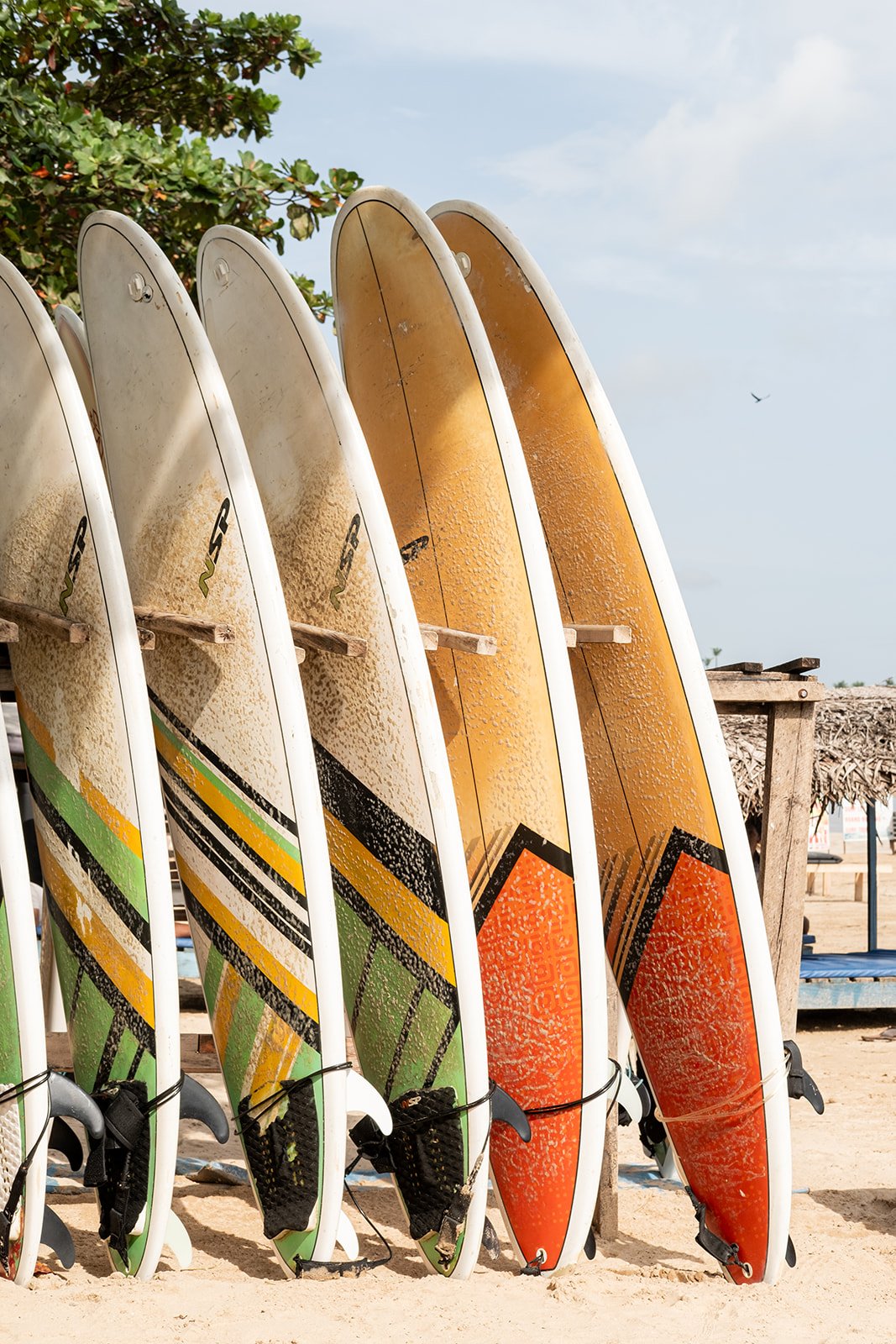
Meet your instructor at our beach base. You’ll be fitted with a soft-top surfboard — wide, thick, and far more stable than a performance board — and a rash guard. Your instructor explains the session structure and asks if you have any concerns or previous water experience.
Safety briefing (15 min)
Your instructor covers ocean awareness, rip current identification and escape, surf etiquette (who has the right of way on a wave), and how to fall safely. This is not a formality — it’s information that protects you every time you surf for the rest of your life.
Land drills — the pop-up (15 min)
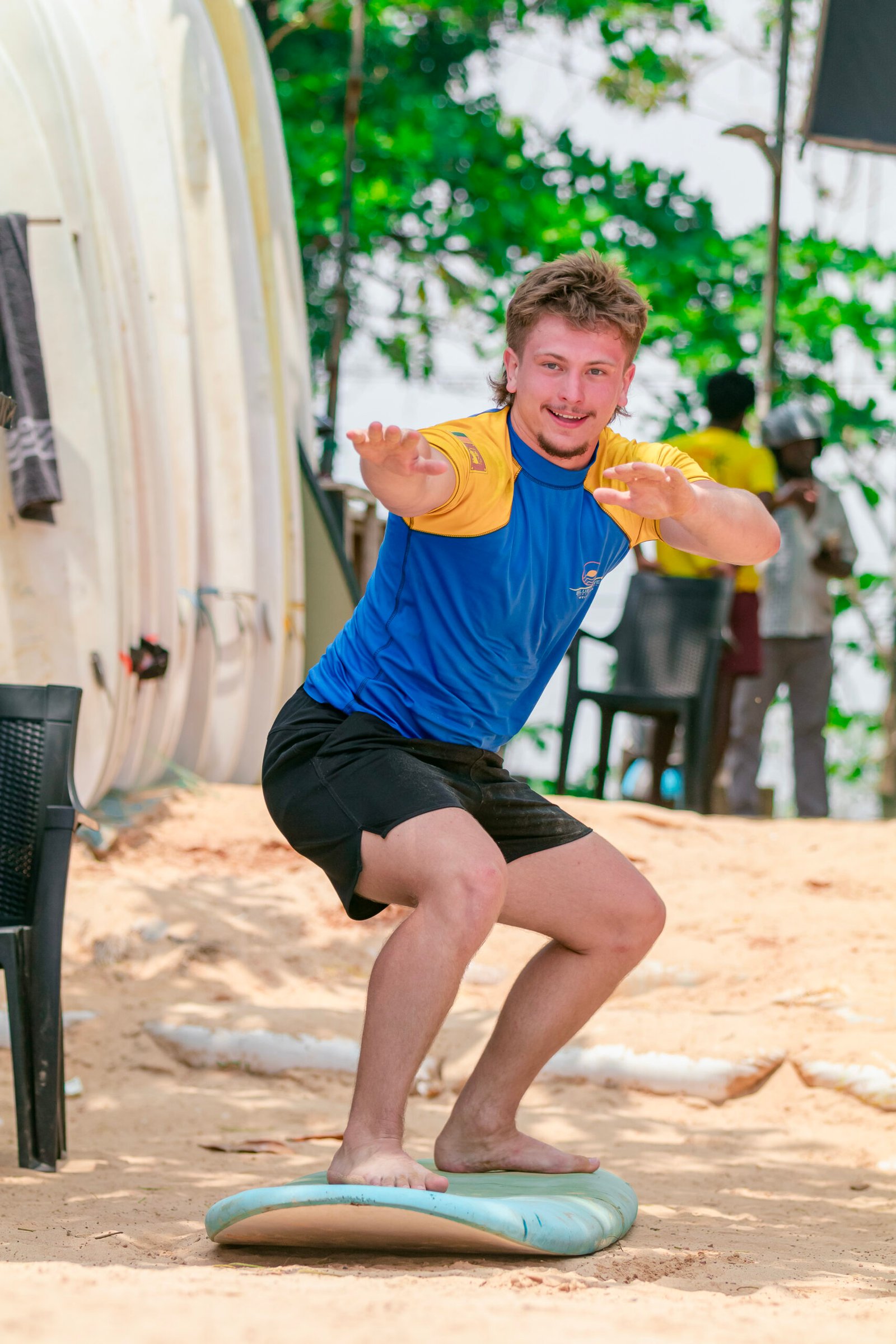
The most important 15 minutes of your surf education. The pop-up is the movement from lying flat on your stomach to standing in one fluid motion. You’ll practise it 10–15 times on the sand until it’s in your muscle memory. Experienced instructors can watch your pop-up on sand and predict almost exactly what will happen in the water.
Common mistakes fixed on the sand:
- Coming up onto your knees before your feet
- Feet placed too narrow (unstable) or too wide (restricted)
- Looking down at the board rather than at the horizon
- Pushing up one hand at a time instead of simultaneously
Whitewash waves (40 min)
Into the water. You start in the whitewash — the foamy, broken part of the wave after it’s already broken. Your instructor positions you on the board, reads the incoming whitewash, and tells you when to pop up. The first attempt will feel chaotic. By the fifth attempt, your body is starting to understand.
Green waves (30 min)
After 30–40 minutes in the whitewash, most students are ready for unbroken (green) waves. Your instructor helps you paddle for real waves — timing your paddle to match the swell — and coaches your pop-up on moving, live waves. This is when it clicks. This is when surfing stops feeling like a lesson and starts feeling like something you want to do every day.
How Long Does It Take to Learn?
The honest answer:
End of lesson 1: Most students stand up and ride whitewashed waves. Many catch green waves by the end.
After 3 lessons: Catching green waves consistently, starting to feel wave selection intuitively.
After 5–7 lessons: Surfing independently, choosing your own waves, making basic turns.
After 2 weeks of daily surfing, you can legitimately say you surf. Not well — but you surf.
Progress depends on how often you surf, your fitness, and whether you practise between lessons. The biggest accelerator is private lessons — one private lesson produces the same technique improvement as roughly three group lessons.
How Much Do Surf Lessons Cost in Weligama?
At Surf & Stays, surf lessons in Weligama cost:
| Lesson Type | Price | Duration | Max Group |
|---|---|---|---|
| Beginner Group | $20 | 2 hours | 6 students |
| Intermediate Group | $25 | 2 hours | 4 students |
| Private 1-on-1 | $45 | 2 hours | 1–2 people |
| Kids & Family | $32 | 90 minutes | Family |
| Surf + Photography | $65 | 90 minutes | Any |
All prices include board, rash guard, safety briefing, and a certified instructor. No hidden charges.
Weligama offers exceptional value compared to other global surf destinations — comparable quality instruction at roughly half the price of Bali and a quarter of Australia or Europe.
Is Weligama Safe for Beginner Surfers?
Yes — with the right precautions in place.
What keeps you safe at Weligama:
Soft-top boards: Our beginner boards are foam surfboards — if you fall on one, it gives. The board itself cannot injure you the way a hard fiberglass board can.
Sandy bottom: The main learning area has no reef exposure at lesson depths. No rocks to land on.
Small groups: Maximum 6 students per instructor for beginners. Your instructor can see every student at all times.
In-water instruction: Our instructors are in the water with you throughout the lesson — not watching from the beach. If you need help, they’re right there.
ISA-certified instructors: Every Surf & Stays instructor holds International Surfing Association certification covering water safety, first aid, and risk assessment.
Stand-up guarantee: Our confidence in our safety procedures and teaching methodology is backed by a guarantee — if you don’t stand up in your first lesson, your next one is free.
What to Bring to Your First Surf Lesson
You need: swimsuit or boardshorts, towel, sunscreen (apply before arriving — reef-safe if possible), water bottle, flip-flops.
We provide: a surfboard, a rash guard, a leash, and all instructions.
Leave behind: jewellery, expensive sunglasses, your phone (unless waterproof).
The water is 28°C. You will not need a wetsuit. You will need sunscreen — the water reflects UV, and you’ll burn faster than you expect.
Common Beginner Questions Answered Honestly
“What if I can’t stand up?” Almost every student stands up in their first lesson. Our stand-up guarantee exists as a commitment, not because we need it. In practice, we very rarely honour it.
“What if I’m not fit enough?” You’ll be sore the day after your first lesson — shoulders, back, and core muscles you rarely use. But you don’t need pre-existing fitness to have a great first lesson. If you can spend 2 hours outdoors and swim 50 metres, you’re ready.
“Is it embarrassing to be a beginner adult?” A significant portion of our students are adults learning for the first time. Our instructors have taught thousands of first-time adult surfers. There is no judgment and no hurry.
“What about jellyfish or sea creatures?” Jellyfish are occasional visitors to Weligama Bay, but not dangerous in these waters. Your instructor will brief you on any specific conditions on the day. Sharks are not a meaningful concern at Weligama.
“What if I panic in the water?” Your instructor is always in the water with you. Signal at any time, and they’ll come immediately. Sessions can be paused or modified at any point.
The Best Time to Take Your First Lesson
Morning sessions (6:30–9 am) are when Weligama is at its best — lightest winds, glassy water, cleanest waves, and fewest people in the water. This is when experienced surfers and instructors alike choose to be in the ocean.
Afternoon sessions are available, but conditions are typically choppier due to sea breezes.
Best months for first-time lessons: November through March for peak conditions. October and April for quieter, more relaxed sessions. Year-round availability.
After Your First Lesson: What Next?
Same day: Rent a board and paddle around Baby Point for an hour. You don’t need to catch waves — just being in the water builds ocean confidence and physical conditioning.
Next day: Book a second lesson. Your body has started adapting. The second lesson feels dramatically better than the first for almost every student.
Rest of your trip: Book a lesson every morning. Surf independently in the afternoon. By day 5 or 6, you’ll feel like a completely different surfer than the person who walked onto the beach for the first time.
Frequently Asked Questions
Is Weligama good for complete beginners who have never surfed?
Yes — Weligama is consistently rated as one of the best places in the world for first-time surfers. Sandy bottom, gentle waves, warm water, and experienced instructors make it the ideal learning environment.
How old do you need to be to learn to surf in Weligama?
We teach from age 5 upwards. Children often progress faster than adults. Family lessons with kids and parents together are available from $32.
Do I need to know how to swim?
Yes — you should be able to swim at least 50 metres comfortably. Lessons take place in shallow water close to shore, but basic swimming ability is a safety requirement.
How many lessons do I need before surfing independently?
Most students are ready to surf independently (in small, beginner-friendly conditions) after 3–5 lessons. We recommend renting a board and practising after each lesson to consolidate what you’ve learned.
Can I book a lesson for the same day?
In shoulder season (October, March–April), usually yes. In peak season (December–February), we recommend booking at least 24–48 hours in advance, and earlier for mornings.
Book your first surf lesson in Weligama from $20. WhatsApp us to confirm your spot in 2 minutes. View all packages →
— Written by the Surf and Stay team, Weligama. Updated June 2026.